Original ScanClick to zoom
Click to zoom
Transcription
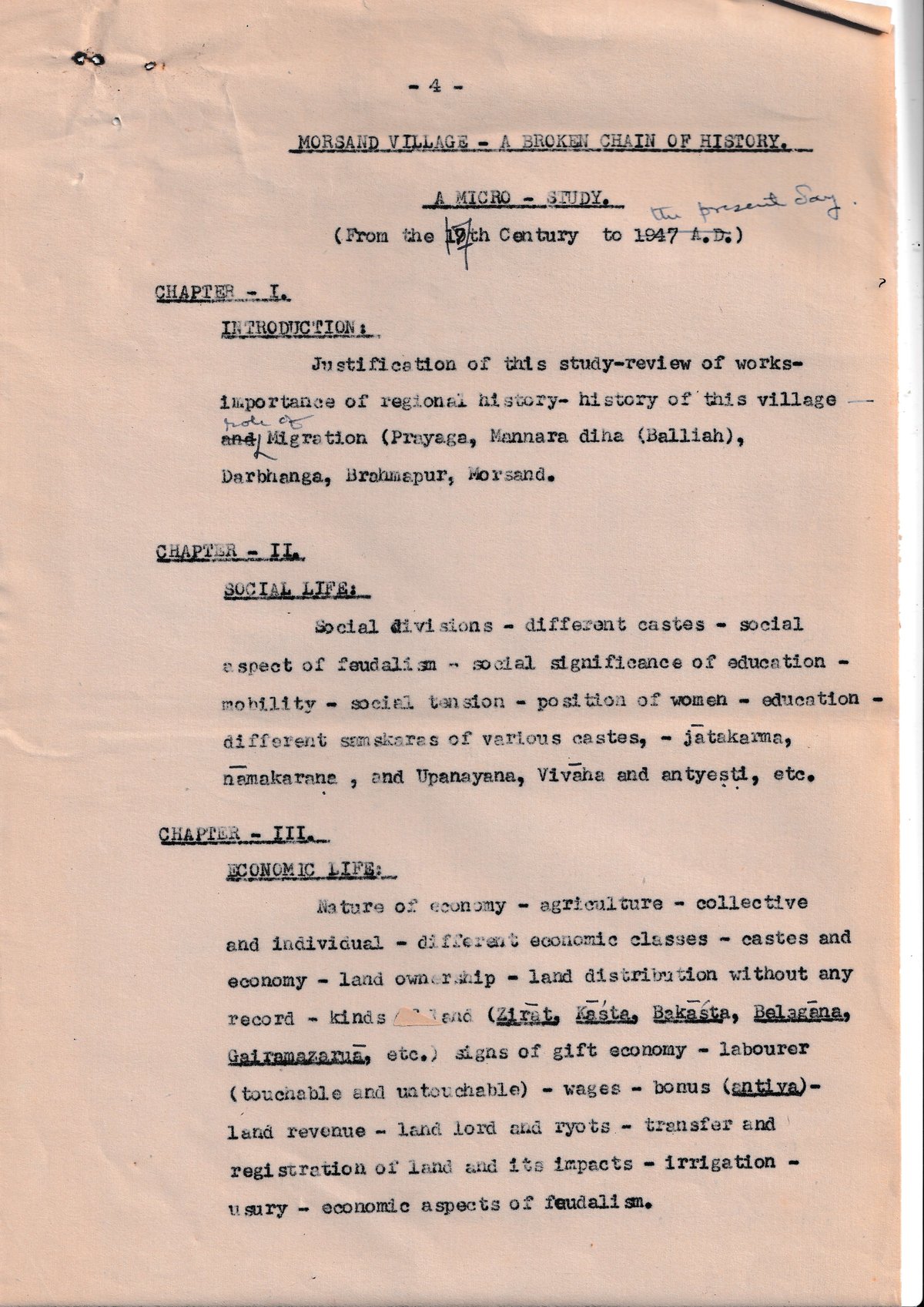
- 4 -
MORSAND VILLAGE - A BROKEN CHAIN OF HISTORY.
A MICRO - STUDY.
(From the 19th Century the present day to 1947 A.D.)
CHAPTER - I.
INTRODUCTION:
Justification of this study-review of works-
importance of regional history- history of this village role of
and Migration (Prayaga, Mannara diha (Balliah),
Darbhanga, Brahmapur, Morsand.
CHAPTER - II.
SOCIAL LIFE:
Social divisions - different castes - social
aspect of feudalism - social significance of education -
mobility - social tension - position of women - education -
different samskaras of various castes, - jatakarma,
namakarana, and Upanayana, Vivaha and antyesti, etc.
CHAPTER - III.
ECONOMIC LIFE:
Nature of economy - agriculture - collective
and individual - different economic classes - castes and
economy - land ownership - land distribution without any
record - kinds of land (Zirat, Kasta, Bakasta, Balagana,
Gairamazarua, etc.) signs of gift economy - labourer
(touchable and untouchable) - wages - bonus (antiva)-
land revenue - land lord and ryots - transfer and
registration of land and its impacts - irrigation -
usury - economic aspects of feudalism.
MORSAND VILLAGE - A BROKEN CHAIN OF HISTORY.
A MICRO - STUDY.
(From the 19th Century the present day to 1947 A.D.)
CHAPTER - I.
INTRODUCTION:
Justification of this study-review of works-
importance of regional history- history of this village role of
and Migration (Prayaga, Mannara diha (Balliah),
Darbhanga, Brahmapur, Morsand.
CHAPTER - II.
SOCIAL LIFE:
Social divisions - different castes - social
aspect of feudalism - social significance of education -
mobility - social tension - position of women - education -
different samskaras of various castes, - jatakarma,
namakarana, and Upanayana, Vivaha and antyesti, etc.
CHAPTER - III.
ECONOMIC LIFE:
Nature of economy - agriculture - collective
and individual - different economic classes - castes and
economy - land ownership - land distribution without any
record - kinds of land (Zirat, Kasta, Bakasta, Balagana,
Gairamazarua, etc.) signs of gift economy - labourer
(touchable and untouchable) - wages - bonus (antiva)-
land revenue - land lord and ryots - transfer and
registration of land and its impacts - irrigation -
usury - economic aspects of feudalism.
Words: 200Low confidence: 6Avg confidence: 90.9%