Original ScanClick to zoom
Click to zoom
Transcription
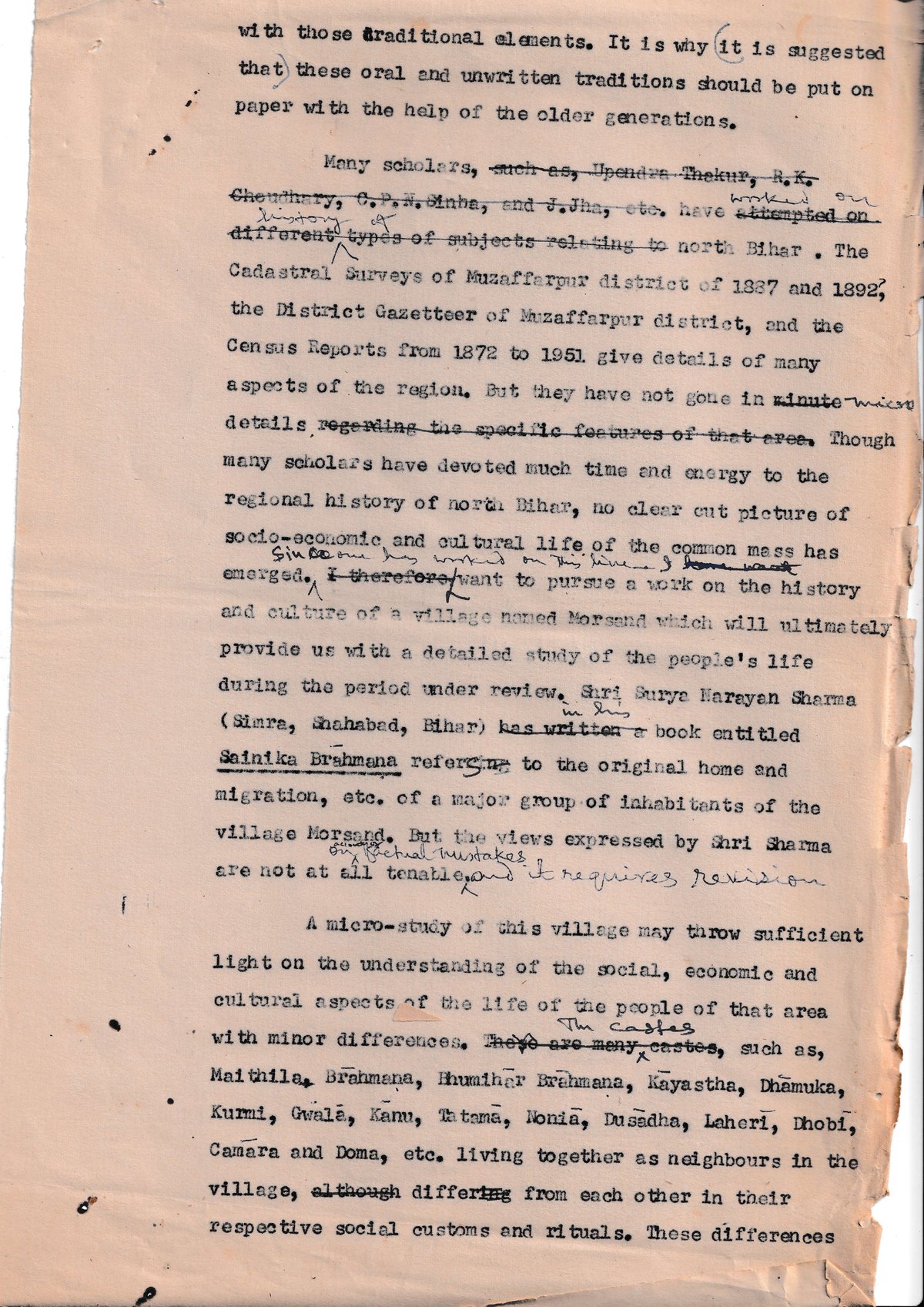
with those traditional elements. It is why it is suggested that these oral and unwritten traditions should be put on paper with the help of the older generations.
Many scholars, such as, Upendra Thakur, R.K. Choudhary, C.P.N. Sinha, and J.Jha, etc. have worked on different types of subjects relating to north Bihar. The Cadastral Surveys of Muzaffarpur district of 1887 and 1892, the District Gazetteer of Muzaffarpur district, and the Census Reports from 1872 to 1951 give details of many aspects of the region. But they have not gone in minute details regarding the specific features of that area. Though many scholars have devoted much time and energy to the regional history of north Bihar, no clear cut picture of socio-economic and cultural life of the common mass has emerged. I therefore want to pursue a work on the history and culture of a village named Morsand which will ultimately provide us with a detailed study of the people's life during the period under review. Shri Surya Narayan Sharma (Simra, Shahabad, Bihar) has written a book entitled Sainika Brahmana referring to the original home and migration, etc. of a major group of inhabitants of the village Morsand. But the views expressed by Shri Sharma are not at all tenable as it is full of mistakes. It requires revision
A micro-study of this village may throw sufficient light on the understanding of the social, economic and cultural aspects of the life of the people of that area with minor differences. There are many castes, such as, Maithila, Brahmana, Bhumihar Brahmana, Kayastha, Dhamuka, Kurmi, Gwala, Kanu, Tatama, Nonia, Dusadha, Laheri, Dhobi, Camara and Doma, etc. living together as neighbours in the village, although differing from each other in their respective social customs and rituals. These differences
Many scholars, such as, Upendra Thakur, R.K. Choudhary, C.P.N. Sinha, and J.Jha, etc. have worked on different types of subjects relating to north Bihar. The Cadastral Surveys of Muzaffarpur district of 1887 and 1892, the District Gazetteer of Muzaffarpur district, and the Census Reports from 1872 to 1951 give details of many aspects of the region. But they have not gone in minute details regarding the specific features of that area. Though many scholars have devoted much time and energy to the regional history of north Bihar, no clear cut picture of socio-economic and cultural life of the common mass has emerged. I therefore want to pursue a work on the history and culture of a village named Morsand which will ultimately provide us with a detailed study of the people's life during the period under review. Shri Surya Narayan Sharma (Simra, Shahabad, Bihar) has written a book entitled Sainika Brahmana referring to the original home and migration, etc. of a major group of inhabitants of the village Morsand. But the views expressed by Shri Sharma are not at all tenable as it is full of mistakes. It requires revision
A micro-study of this village may throw sufficient light on the understanding of the social, economic and cultural aspects of the life of the people of that area with minor differences. There are many castes, such as, Maithila, Brahmana, Bhumihar Brahmana, Kayastha, Dhamuka, Kurmi, Gwala, Kanu, Tatama, Nonia, Dusadha, Laheri, Dhobi, Camara and Doma, etc. living together as neighbours in the village, although differing from each other in their respective social customs and rituals. These differences
Words: 362Low confidence: 21Avg confidence: 90.6%