Original ScanClick to zoom
Click to zoom
Transcription
MORSAND VILLAGE - A BROKEN CHAIN OF HISTORY
A MICRO - STUDY.
(From the 17th Century to 1947 A.D.)
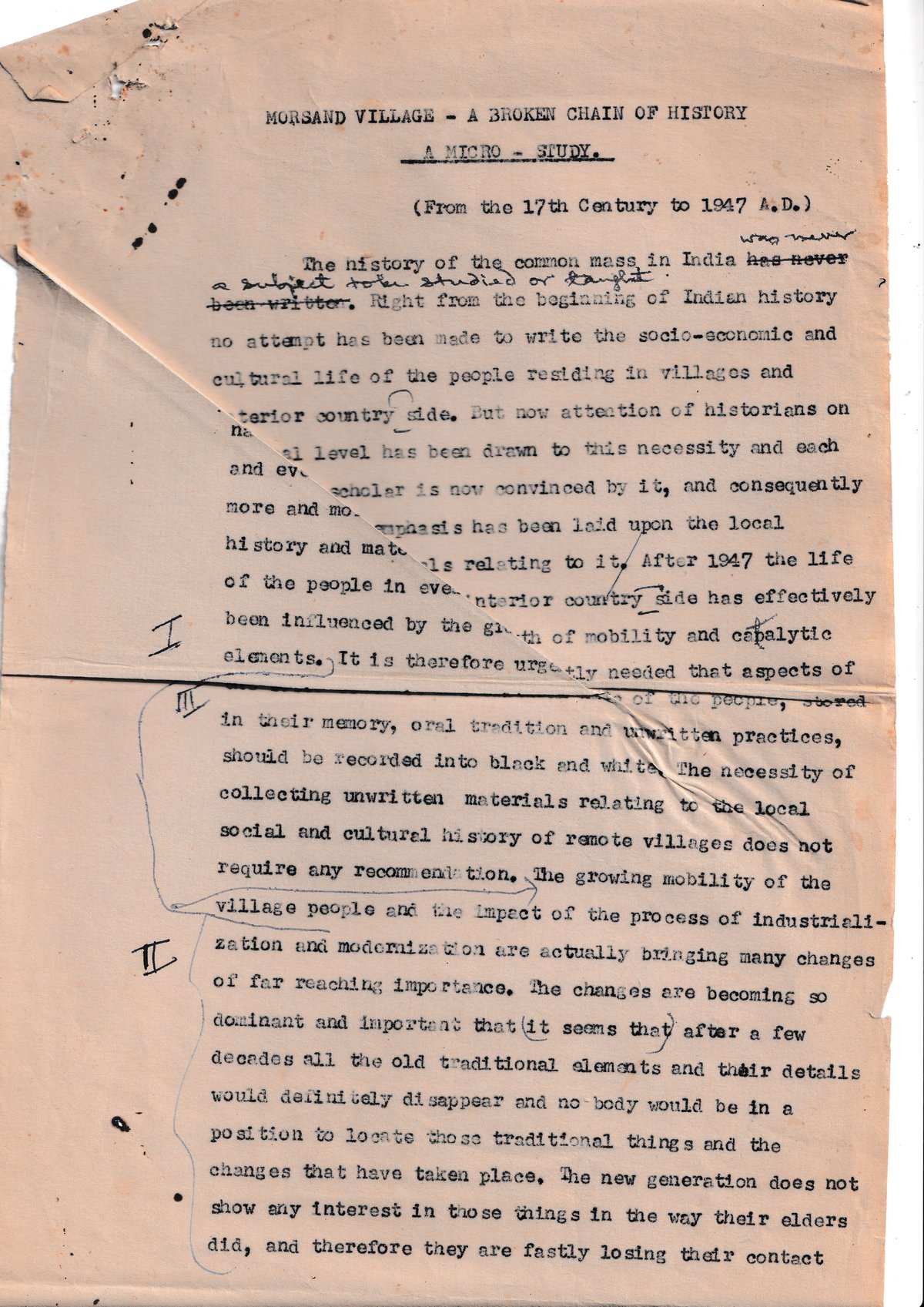
The history of the common mass in India has never been written as a subject to be studied or taught. Right from the beginning of Indian history no attempt has been made to write the socio-economic and cultural life of the people residing in villages and interior country side. But now attention of historians on national level has been drawn to this necessity and each and every scholar is now convinced by it, and consequently more and more emphasis has been laid upon the local history and materials relating to it. After 1947 the life of the people in every interior country side has effectively been influenced by the growth of mobility and catalytic elements. It is therefore urgently needed that aspects of the life of the people, stored in their memory, oral tradition and unwritten practices, should be recorded into black and white. The necessity of collecting unwritten materials relating to the local social and cultural history of remote villages does not require any recommendation. The growing mobility of the village people and the impact of the process of industrialization and modernization are actually bringing many changes of far reaching importance. The changes are becoming so dominant and important that it seems that after a few decades all the old traditional elements and their details would definitely disappear and no body would be in a position to locate those traditional things and the changes that have taken place. The new generation does not show any interest in those things in the way their elders did, and therefore they are fastly losing their contact
A MICRO - STUDY.
(From the 17th Century to 1947 A.D.)
The history of the common mass in India has never been written as a subject to be studied or taught. Right from the beginning of Indian history no attempt has been made to write the socio-economic and cultural life of the people residing in villages and interior country side. But now attention of historians on national level has been drawn to this necessity and each and every scholar is now convinced by it, and consequently more and more emphasis has been laid upon the local history and materials relating to it. After 1947 the life of the people in every interior country side has effectively been influenced by the growth of mobility and catalytic elements. It is therefore urgently needed that aspects of the life of the people, stored in their memory, oral tradition and unwritten practices, should be recorded into black and white. The necessity of collecting unwritten materials relating to the local social and cultural history of remote villages does not require any recommendation. The growing mobility of the village people and the impact of the process of industrialization and modernization are actually bringing many changes of far reaching importance. The changes are becoming so dominant and important that it seems that after a few decades all the old traditional elements and their details would definitely disappear and no body would be in a position to locate those traditional things and the changes that have taken place. The new generation does not show any interest in those things in the way their elders did, and therefore they are fastly losing their contact
Words: 309Low confidence: 10Avg confidence: 93.2%